What It Is
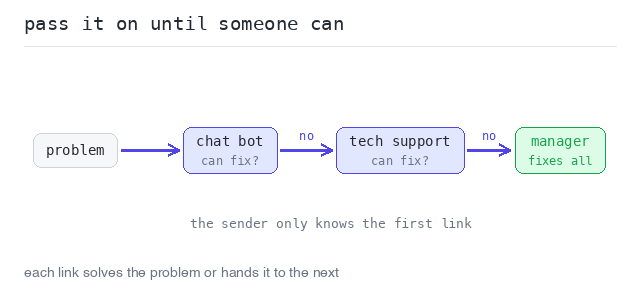
The Chain of Responsibility pattern passes a request along a chain of handlers. Each handler either deals with the request or hands it to the next one. The sender only knows the first link — never who will actually solve it.
Example: A Support Line
A problem enters at the chat bot. What the bot cannot fix goes to tech support; what tech support cannot fix goes to the manager, who handles everything that arrives.
Pass it on until someone can
"No internet" travels one step and stops at tech support; the refund request travels the whole chain to the manager. The caller wrote the same one line both times. The nullsafe call $this->next?->handle() simply stops at the end of the chain.
Output: PHP script
<?php

class Handler {
  public function __construct(
    private string $name,
    private \Closure $canFix,
    private ?Handler $next = null,
  ) {}

  public function handle(string $problem): void {
    if (($this->canFix)($problem)) {
      echo $this->name, " solved: ", $problem, "\n";
      return;
    }
    echo $this->name, " passes it on\n";
    $this->next?->handle($problem);
  }
}

$manager = new Handler("manager", fn(string $p) => true);
$tech = new Handler("tech support", fn(string $p) => $p === "no internet", $manager);
$bot = new Handler("chat bot", fn(string $p) => $p === "forgot password", $tech);

$bot->handle("no internet");
echo "---\n";
$bot->handle("refund request");
When to Use It
Use it when several parties might handle a request and the right one is not known in advance — support escalation, middleware, event handling, approval workflows.
Skip it when the handler is always known — call it directly. A chain with one link, or one that always ends at the same link, is a plain function call in costume.
Pros and Cons
Pros: sender and receivers are decoupled; links can be added, removed and reordered freely; each handler stays small.
Cons: no guarantee anyone handles the request — a broken chain swallows it silently; following a request through many links makes debugging slower.